
What a Phone Check Can and Cannot Tell You About a 0.005 BTC Goal
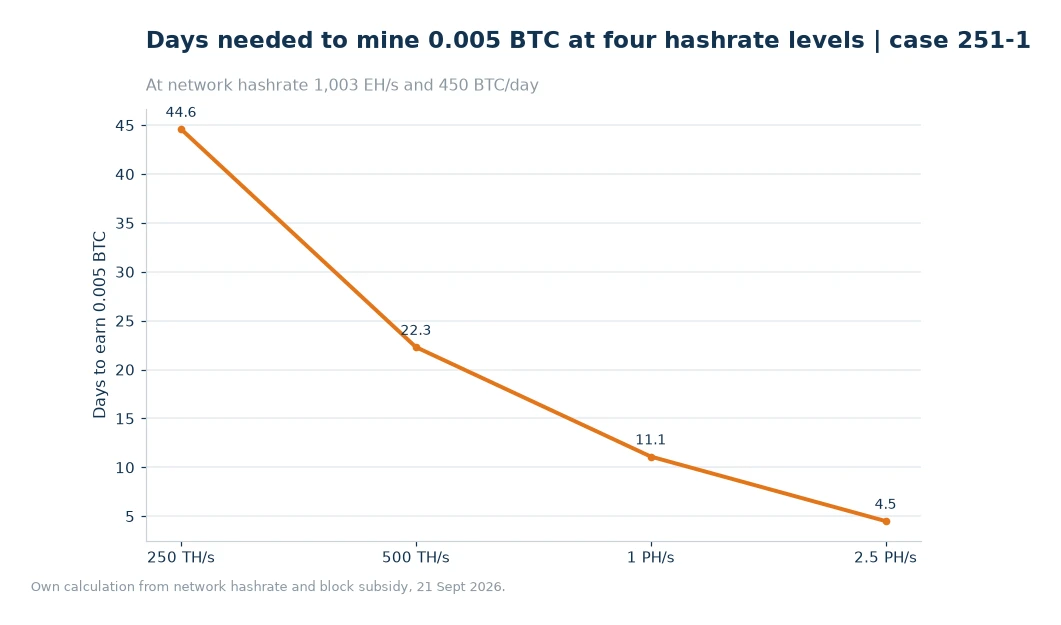
A balance on a phone is a lagging indicator, and a 0.005 BTC goal takes 44.6 days at 250 TH/s, 22.3 at 500 TH/s, 11.1 at 1 PH/s and 4.5 at 2.5 PH/s on the 21 September 2026 network total. Checking every morning tells you what has already arrived, never whether the machine is still producing at the right rate. Separating those two readings is the whole skill of remote monitoring.
Key takeaways
- A 0.005 BTC target is 44.6 days of work at 250 TH/s, so daily balance moves are small.
- Reported hash rate changes within minutes of a fault; the balance takes hours to show it.
- Two coin lines means two reconciliations, and the smaller line is the easier one to forget.
- One five-minute check a week beats a daily glance at a number that cannot move much.
A Balance Is a Lagging Indicator
Every dashboard puts the balance first because it is the number people care about. It is also the slowest number to react. A machine that stops at midnight changes its reported hash rate immediately, but the balance only stops growing at the rate it was growing, which on a small account is a few dollars an hour.
For remote monitoring the order should be reversed: hash rate first, payout history second, balance third. The first answers whether the work is happening, the second whether it is being credited, and the third is an accumulated consequence of both.
The Six-Week Case at 250 TH/s
At 250 TH/s the daily credit is 0.00011216 BTC, and 0.005 BTC arrives after 44.6 days, a little over six weeks. That horizon is long enough that a two-day outage is invisible in the final total but obvious in the weekly rate, which is exactly why the rate deserves its own screen.
Six weeks also spans at least one difficulty adjustment, so the expected daily figure at the end of the period will not be the one at the start. A phone check that compares today with the first day will show a small decline that is entirely normal. Comparing today with last week is the fairer test.
Three Screens Worth Opening
The ViaBTC LTC Mining Pool view gives the pool's share and the luck figure. Your own worker panel gives the rate each machine reports. The wallet gives the credited balance and the payout history. Three screens, thirty seconds each, and between them they cover almost every failure a remote operator can detect.
Pool Luck belongs on the first screen because it prevents a misdiagnosis. A PPLNS account with a healthy hash rate and an unlucky stretch will show a thinner credit, and the correct response is to wait, not to restart hardware. Without the luck figure the natural reaction is to interfere, which usually costs more uptime than the variance did.
Reconciling Two Coins on a Small Screen
Scrypt pools usually credit two coins, so the balance view has two lines. The primary one is large enough to notice; the merged mining line is smaller and easier to overlook, which is why it should be checked on a schedule rather than by accident. Compare the ratio between the two lines week to week: a sudden change in the ratio means one stream stopped, even if the total still looks plausible.
The multi-currency wallet keeps both balances in one place, so the comparison needs no export. If the smaller line disappears entirely, treat it as a configuration issue and check the account before touching the machines.
When the Number on the Phone Looks Wrong
There are three common causes, and they are distinguishable in order. A worker that stopped shows as a zero or a missing rig on the rate screen. A pool-side variance event shows as normal rate with a thin credit and a low luck figure. A price move shows as an unchanged coin balance with a different dollar value, which is not a mining problem at all.
Working through those three in that order takes about a minute and prevents most unnecessary site visits. The dollar figure is the last thing to check, not the first, because it moves for reasons the hardware cannot influence. A fall in the coin balance, by contrast, always has a mining or payout explanation behind it.
Keep a note of what the account looked like at the last weekly check. Without that baseline, a flat balance is ambiguous: it could mean a stopped worker or a quiet payout window. With it, the same observation is a comparison and takes seconds to interpret.
A Weekly Routine That Fits in Five Minutes
Once a week, note three numbers: the reported hash rate, the coin credited since the last check, and the pool's luck reading. Compare each with the previous week. A single week's deviation is noise; two consecutive weeks in the same direction is a trend worth investigating.
The table converts four hash rates into weekly expectations, which is the form a five-minute check needs. Weekly figures are easier to compare than daily ones because the daily number is small enough for rounding to matter. Set the note beside the phone reminder so the comparison is a glance rather than a calculation.
A useful addition is the expected number of payouts in the week. If the account normally receives 168 hourly credits at a given rate, a week with 140 is a signal, while a week with 168 is simply normal. Counting credits is often faster than summing them.
| Hash rate | Days to 0.005 BTC | BTC per week | USD per week |
|---|---|---|---|
| 250 TH/s | 44.6 | 0.00078512 | $66.49 |
| 500 TH/s | 22.3 | 0.00157031 | $132.99 |
| 1 PH/s | 11.1 | 0.00314057 | $265.97 |
| 2.5 PH/s | 4.5 | 0.00785143 | $664.93 |
Worked example
The 250 TH/s case, converted into the weekly number a phone check can use.
- Daily issuance: 144 × 3.125 = 450 BTC.
- Per terahash: 450 ÷ 1,003,000,000 = 0.00000044865 BTC.
- At 250 TH/s: 0.00011216 BTC a day.
- Days to 0.005 BTC: 0.005 ÷ 0.00011216 = 44.6.
- Weekly output: 7 × 0.00011216 = 0.00078512 BTC.
- Weekly value: 0.00078512 × 84,692 = $66.49.
- At 1 PH/s: 0.00044865 a day, so 0.00314057 BTC a week, or $265.97.
- At 2.5 PH/s: 0.00112163 a day, so 0.00785143 BTC a week, or $664.93.
Frequently asked questions
How often should I check a remote mining account?
Once a week is enough for a stable operation, with alerts covering anything faster. The balance moves too slowly to justify a daily look, while a hash-rate alert catches a failure within minutes.
Why is my balance flat while the hash rate looks normal?
Payout timing and pool luck are the usual reasons. A PPLNS account credits after confirmations and shares the pool's block discovery, so a quiet stretch can leave the balance unchanged while the hardware works normally.
Do I need to check the second coin separately?
Yes. The merged mining stream is smaller and easier to miss, so compare its ratio to the primary coin each week. A stream that vanishes is a configuration issue rather than a hardware failure.
Make the Rate the First Number
Put the hash rate at the top of the weekly note, the credited coin in the middle and the dollar value at the bottom. That order matches the speed at which each number can reveal a problem. The ViaBTC App can carry the alerts that make the weekly check sufficient.
After a month the note becomes a record, and a record is what turns a vague sense that the machines are fine into evidence. That is worth more than any single glance at a balance.
Readings taken 21 Sept 2026 from the ViaBTC LTC pool, wallet and app pages[1]. Constants used: 1,003 EH/s, 3.125 BTC subsidy per block, 144 blocks a day, BTC $84,692, LTC $59.32. Published 24 Oct 2026; weekly outputs assume no downtime.